
"Behind the scenes" at our Estambul shop in Granada
Heritage & tradition
Meet Ahmet Kesmegülü, the origins of Pastelería Estambul in Granada, and the values behind every tray of baklava that leaves our workshop. A journey through our mission, craft, and the artisan process we have kept alive since 1987 in the historic center.
Origins
Pastelería Estambul was born from a personal story before it was ever a business plan. Ahmet Kesmegülü arrived in Granada as a computer science student, drawn to the city and its people, but with nostalgia for Turkey always present: the aromas of family pastry, çay served without hurry, the crunch of freshly baked filo.
That blend of discovery and longing led him to imagine a space where he could share an authentic piece of his culture. He was not looking for a tourist shop, but an honest place where Granadinos could taste baklava, lokum, and Turkish tea made with the same respect as in the neighborhood bakeries of Istanbul.
In 1987 he opened the first shop in the historic center. What began as a small workshop grew with the trust of those who kept coming back: he had found in Granada a flavor that was not in any other shop window.
From student to entrepreneur
Ahmet's transition was not linear. Trained in computer science, he came to Andalusia on an academic exchange and fell in love with Granada: its streets, its pace, the hospitality of its neighbors. But every visit to a local bakery brought back memories of the sweets of his childhood.
Learning the craft took years. Family recipes, hand-stretched filo techniques, the judgment to choose pistachios and honey, all of it far from the screens and code he mastered at university. He also had to understand the Granadan market: regulations, suppliers, the hours of a business that does not allow improvisation if you want to maintain quality day after day.
The leap from student to entrepreneur was, above all, a leap of vocation. Ahmet did not abandon his training: he applied it methodically to the workshop, to logistics between shops, and to the consistency required to make artisan baklava every morning for nearly four decades.
Our mission
Our mission is clear: to craft authentic Turkish sweets and share them with those looking for more than a sweet indulgence. We want every visit to be a small window onto Ottoman pastry, without industrial shortcuts, without flavors that betray their origins.
That means respecting non-negotiable timings: filo resting, small-batch baking, refreshing the display cases throughout the day. It also means bringing that tradition to Granada naturally, as an honest complement to the Andalusian gastronomic richness that already lives in the city.
More than selling desserts, we want those who enter Zacatín or Calderería Nueva to understand the story behind every tray: where the Gaziantep pistachios come from, why we use natural honey, and what makes the difference between hand-made baklava and one produced on an assembly line.
Core values
Authenticity: inherited recipes and techniques we do not replace for convenience. If a step requires hand-stretched filo or top-grade pistachios, we do not cut corners.
Passion: the workshop team shares the same pride in the craft. That enthusiasm shows in how we treat you, in how we explain each variety, and in the care with which every box is presented.
Tradition: we honor Turkish pastry and, at the same time, Granada's cultural fabric. We are a bridge, not an exotic escape.
Quality: selected ingredients, Gaziantep pistachios, natural honey, premium nuts, and rigorous standards in every batch. What does not meet that level does not reach the display case.
Artisan process
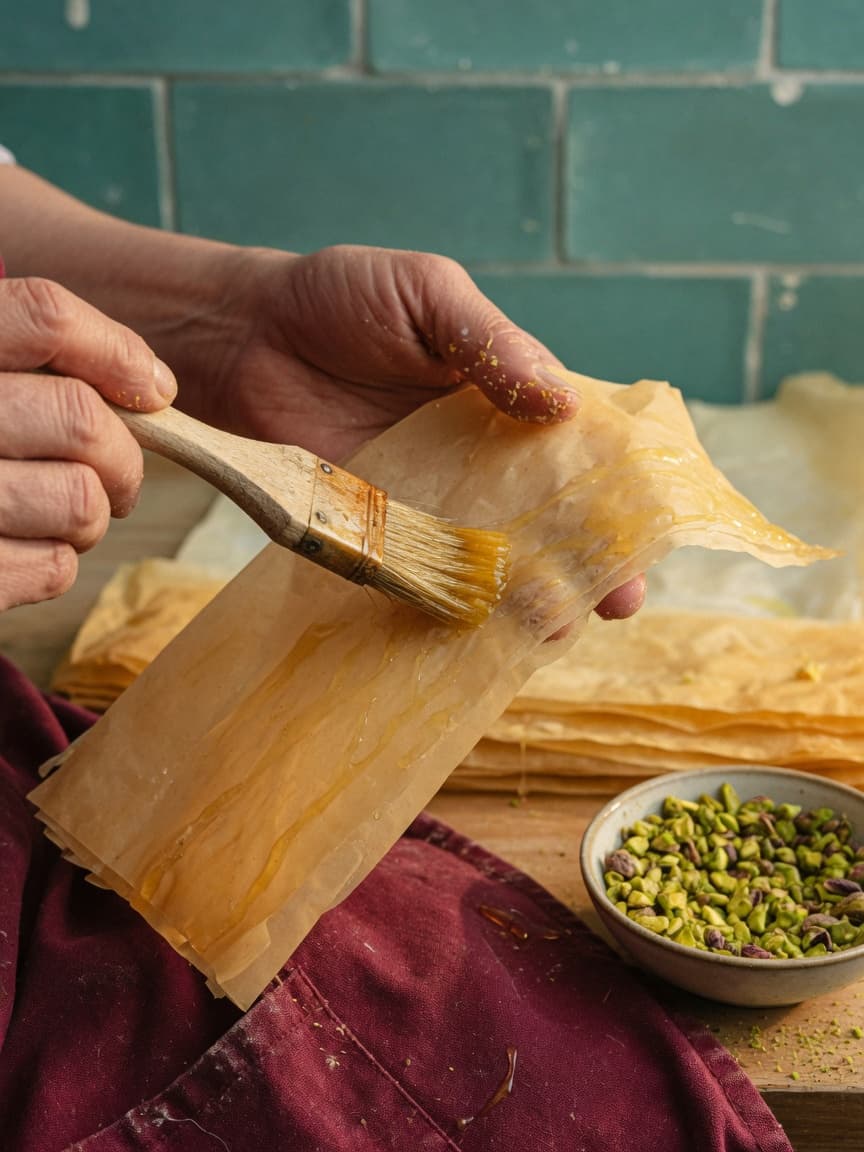
The day in the workshop begins before the shops open. We prepare the filo, layer it with clarified butter, distribute freshly chopped pistachios, and bake in small batches to control the exact point of crispness.
The syrup, with natural honey and a carefully balanced sweetness, is poured over hot baklava, just out of the oven. That contrast defines the texture: layers that absorb the syrup without losing their golden exterior.
Lokum, kataifi, and other specialties follow their own rhythms, but the same philosophy: daily production, with no industrial stock in the background. What you see at C. Zacatín 11 and C. Calderería Nueva 5 is the result of hours of work, not a distant warehouse.
A cultural bridge with Granada
Granada and Istanbul have more in common than first meets the eye. Centuries of Andalusian heritage left the city a memory of spices, sugar, and hospitality that speaks to Turkish culture without forcing the comparison.
In our shops, tourists discovering baklava for the first time, Granadan families returning for celebrations, and Albaicín neighbors looking for something distinctive for their guests all come together. That mix of audiences confirms that sweets can unite without needing too much translation: flavor speaks first.
Ahmet arrived as a foreign student; today Pastelería Estambul is part of the city's sweet map. We do not aim to replace local pastry, but to enrich it with a tradition that fits a Granada that is open, curious, and accustomed to encounters.
How to enjoy the experience
The simplest way to get to know us is to step in without rushing. Order a çay brewed in a çaydanlık, try a piece of pistachio baklava, and ask the team about the day's varieties. No reservation or fixed menu is needed: the display case and the aroma will guide you.
If you are walking through the center, our shop at C. Zacatín 11 is just minutes from the Cathedral. If you climb into the Albaicín, C. Calderería Nueva 5 awaits you among alleyways and artisan workshops. In both locations you will find the same standard of craftsmanship and the same hospitality.
Take a box home, share an assortment at a celebration, or combine the visit with a stroll through the historic center. Behind every shop window is a story that began with a student's nostalgia and today is shared, bite by bite, with Granada.