
Artisan baklava in Granada: how it is made step by step
Artisan baklava
What happens before baklava reaches the display case? We walk you step by step through the artisan process in our Granada workshop: filo, nuts, syrup, baking, and resting, no shortcuts, with the patience Turkish tradition demands.
Introduction to baklava
Baklava is one of the great emblems of Turkish pastry. Fine layers of filo, generous nuts, and a syrup that wraps everything in a golden shine: simple in concept, demanding in execution.
In Turkey it is served at celebrations, visits, and unhurried çay afternoons. In Granada we make it with the same respect for its origins, adapting logistics to a workshop that supplies two shops in the historic center.
What follows is not a home recipe to improvise on a Sunday, it is the process we repeat every morning since 1987, with the hands and timings the craft demands.
Key ingredients
The base is filo: paper-thin, delicate, almost translucent. We stretch it by hand and handle it carefully so it does not tear or become too moist between layers.
On the filo go the nuts. In our pistachio varieties we use Gaziantep grains chopped at the last moment, their green color and floral aroma make the difference against lower-quality pistachios.
Clarified butter ensures the golden crunch; natural honey and sugar make up the syrup with a balanced sweetness that does not cloy. Every ingredient has a role; none is superfluous.
Workshop tools
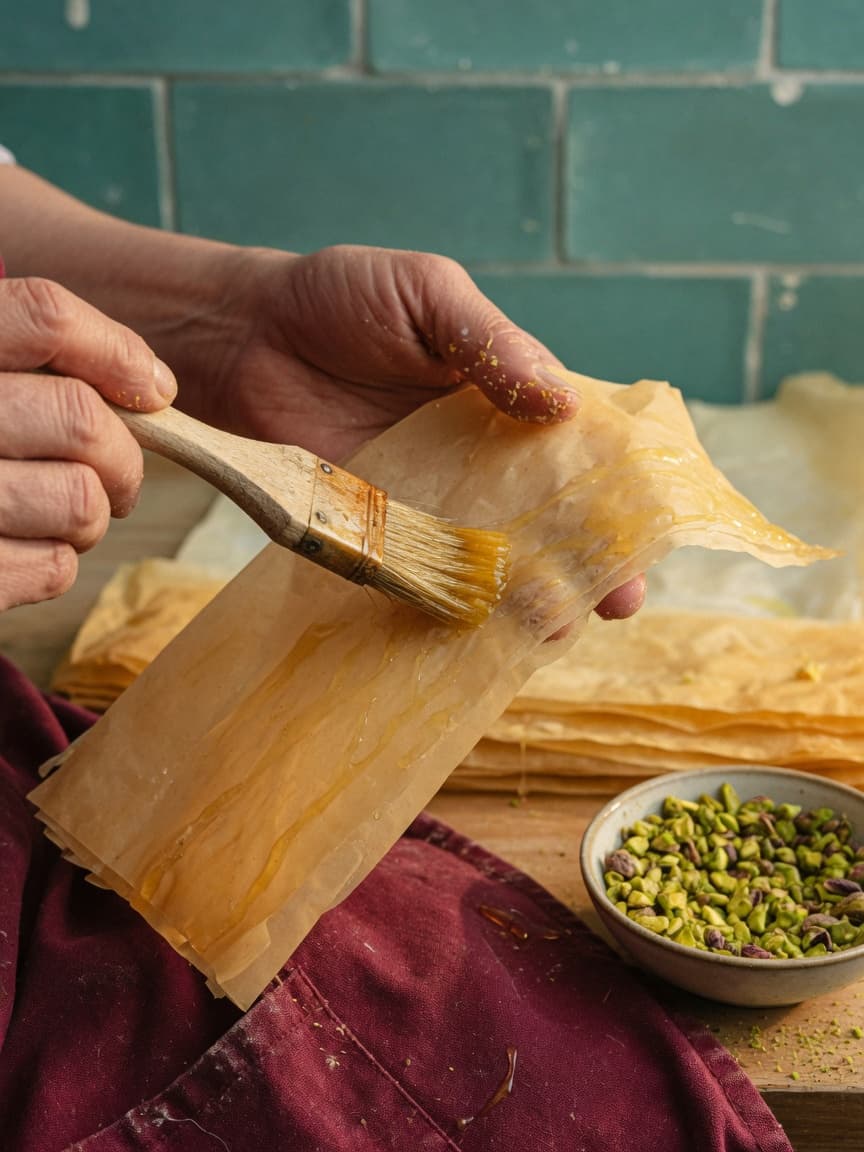
A baking tray with good conductivity, a sharp knife for precise cutting, and a brush to distribute butter between layers: simple tools, indispensable.
The knife defines the presentation. We cut the baklava before baking, in diamonds, squares, or fingers, so the syrup penetrates evenly afterward and each portion separates cleanly.
In the workshop there is no automated assembly line. There are tables, trays, and hands that know the exact point at which the filo stops accepting another layer without losing texture.
Layer-by-layer preparation
We build the baklava alternating layers of filo and butter with generous portions of pistachio or walnut. Too much filling crushes the layers; too little leaves the dessert empty. The proportion is learned over years, not with a scale.
Each format, classic square, fingers, kataifi nests, has its own assembly logic. The pace is unhurried: one layer, butter, another layer, filling, and so on until the tray is complete.
That work begins before dawn so the Zacatín and Calderería shops open with full display cases and fresh product.
Cutting and presentation
Cutting before baking is a signature of the craft. It is not just aesthetics: it determines how the syrup will circulate and how crispness will hold in each portion.
We bake to the exact point of golden color, neither pale nor burnt, and remove the tray with the same care with which the filo was placed hours earlier.
Presentation in the display case follows practical criteria: the freshest at the front, varieties identified so those who enter know what to try without a long catalogue.
Syrup at the right moment
Syrup is the liquid soul of baklava. We prepare it with natural honey and sugar in measured proportions, sometimes with a touch of lemon or orange blossom water depending on the variety.
The crucial moment is pouring it: over hot baklava, just out of the oven. The temperature contrast allows each layer to absorb the syrup without losing its outer crunch.
That balance, hot and cold, sweetness and texture, is what separates a good result from a mediocre one. It cannot be rushed or improvised.
Resting and freshness
The final step is the hardest for anyone in a hurry: waiting. Baklava needs to rest so the syrup distributes, the layers settle, and the flavors integrate.
At Pastelería Estambul we respect those timings every morning, producing batches that supply our downtown and Albaicín shops with product of the day.
When you taste it, you are tasting hours of work, not a production line, and that shows in every layer.
Varieties in Granada
In our display cases you will find classic pistachio baklava, assorted fingers, chocolate varieties, and kataifi nests, each with its own assembly and filling proportion.
All share the same standard: hand-stretched filo, Gaziantep pistachios where appropriate, balanced syrup, and respected resting times.
Stop by C. Zacatín 11 or C. Calderería Nueva 5, ask about the variety of the day, and taste on the palate what the workshop has prepared since before dawn.